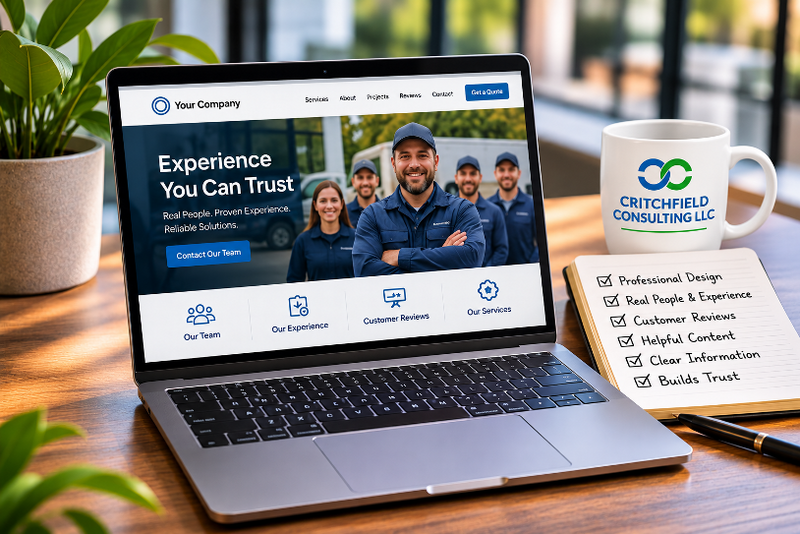
How Website Design, Real Experience, and Credibility Help Build Trust Online
Your website is often the first meaningful interaction a potential customer has with your business. Before someone calls, submits a form, or requests a quote, they're evaluating whether your company appears professional, experienced, and trustworthy.
Search engines are also working to identify helpful, reliable information when determining which websites to surface.
Although customers and Google evaluate websites differently, many of the fundamentals overlap. Clear information, demonstrated experience, professional presentation, and credible content all contribute to a stronger online presence.
So, what makes a website trustworthy?
First Impressions Matter More Than Ever
A professional website doesn't automatically make a business trustworthy, but poor design can quickly create doubts.
Outdated layouts, broken links, confusing navigation, slow-loading pages, and inconsistent branding can leave visitors questioning whether a company is established and dependable.
A trustworthy website should make it easy to understand what the business does, who it serves, and how to get in touch.
Mobile responsiveness, intuitive navigation, clear calls to action, and professional design help create a positive first impression while making the website easier to use.
Good website design isn't just about appearance. It's about removing uncertainty and helping customers feel confident taking the next step.
Show the Real People Behind Your Business
One of the most overlooked opportunities in website development is showcasing the actual people who make a business successful.
Customers want to know who they're hiring, especially when making significant purchasing decisions or selecting professional services.
Consider including:
-
Company History: Explain how your business started, how it has evolved, and what experience you've gained.
-
Leadership and Team Members: Introduce the people responsible for delivering your products or services.
-
Original Photography: Show your employees, facilities, equipment, projects, and everyday operations.
-
Credentials and Affiliations: Highlight relevant certifications, professional memberships, and industry qualifications.
Stock photography has its place, but original images often tell a more convincing story.
Real people, real facilities, and real experience help distinguish your business from competitors relying on generic website content.
Demonstrate Experience Instead of Making Claims
Almost every company claims to provide exceptional service, outstanding quality, or industry-leading expertise.
But what evidence supports those statements?
A trustworthy website should demonstrate experience through meaningful examples.
Customer testimonials, project portfolios, case studies, and detailed service information help prospective customers understand what your company has accomplished.
For example, a website design agency can describe its capabilities, but showcasing completed projects and explaining the challenges addressed provides stronger evidence.
Similarly, a law firm can build credibility by introducing its attorneys, explaining relevant experience, and helping visitors understand the legal matters it handles.
At Critchfield Consulting, we prioritize incorporating these elements into our website design projects, showcasing real businesses, their capabilities, and the work we've completed. Because demonstrating expertise is more compelling than simply claiming it.
How Google Evaluates Website Credibility
Google uses the concept of EEAT: Experience, Expertise, Authoritativeness, and Trustworthiness, within its Search Quality Rater Guidelines.
These principles help describe characteristics of high-quality, reliable content.
-
Experience: Does the content reflect firsthand knowledge or practical involvement?
-
Expertise: Does the author or business demonstrate relevant knowledge?
-
Authoritativeness: Is the business recognized as a credible source within its field?
-
Trustworthiness: Is the information accurate, transparent, and dependable?
Importantly, EEAT is not a numerical Google ranking score that businesses can improve simply by adding a few website elements.
Instead, it provides a useful framework for evaluating content quality and credibility.
For a deeper explanation of how these principles relate to organic visibility, visit our Complete Guide to SEO for Small Businesses.
Build Trust Through Better Website Content
Credibility extends beyond your About page.
Every important page should provide useful, accurate information that helps visitors make informed decisions.
Detailed service descriptions, relevant FAQs, updated company information, and educational articles can address questions before customers ever contact you.
Internal linking helps visitors navigate between related information, while appropriate Schema markup provides search engines with structured details about your business and content.
Neither guarantees higher rankings or inclusion in AI-generated answers, but both can support a better-organized website.
Just as importantly, regularly reviewing your content helps ensure that services, employee information, locations, and business capabilities remain accurate. As we explain in Your Website Isn't Finished After It Launches, maintaining and improving your website is an ongoing responsibility, not a one-time project.
An outdated website can undermine trust even when the company behind it provides excellent service.
Is Your Website Building Customer Confidence?
Take a moment to evaluate your website from a prospective customer's perspective.
Can visitors quickly identify who you are and what you offer? Can they find genuine evidence of your experience? Are your services explained clearly? Does the website make contacting your business easy?
If those answers aren't immediately apparent, your website may be missing opportunities to establish credibility and convert visitors into customers.
At Critchfield Consulting, our 31-point Digital Marketing Evaluation examines website design, SEO, content, user experience, and other factors influencing online performance.
Because a successful website should do more than attract visitors.
It should give people the information, evidence, and confidence they need to choose your business.