One of the most common questions we hear at Critchfield Consulting is simple:
“Why isn’t my website ranking?”
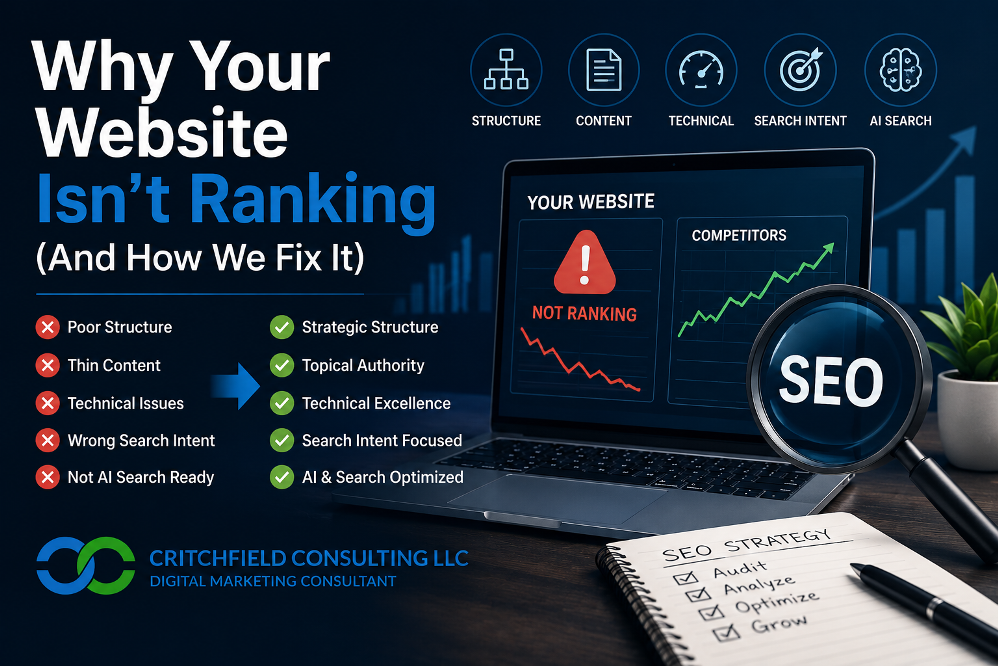
Most business owners assume the answer is a lack of keywords or not enough blog posts. In reality, the issue is usually much deeper.
Today’s search engines and AI-driven platforms like Google AI Overviews, ChatGPT, Gemini, and Perplexity evaluate websites differently than they did even a few years ago.
Modern SEO is no longer just about rankings. It’s about structure, clarity, authority, search intent, and user experience.
At Critchfield Consulting, we help businesses uncover what’s actually hurting their visibility and build strategies designed to improve long-term performance.
Most Websites Aren’t Built Around Search Intent
One of the biggest SEO mistakes businesses make is creating content around what they want to say instead of what customers are actually searching for.
Search intent matters more than keyword stuffing.
Google and AI search systems now prioritize:
- Clear answers to user questions
- Helpful educational content
- Well-structured service pages
- Content that demonstrates expertise and trust
If your pages don’t align with what users actually need, rankings suffer regardless of design quality.
This is one reason we focus heavily on strategy-driven content development instead of generic SEO copy.
Poor Website Structure Confuses Search Engines
Many websites are difficult for both users and search engines to navigate.
Weak page hierarchy and poor internal linking make it harder for Google to understand what your business actually does.
Common issues include:
- Disorganized navigation
- Missing service-specific pages
- Broken internal linking
- Thin content and pages
- Orphan pages with no supporting structure
Strong SEO requires a strong framework.
Learn more about website navigation and structure and how it impacts both SEO and user experience.
Thin Content and Generic AI Copy Hurt Rankings
AI-generated content has exploded across the internet, but most businesses are using it incorrectly.
Publishing shallow, generic content without strategy often weakens authority instead of improving it.
Search engines now reward:
- Topical depth
- Original insights
- Real expertise
- Helpful structure
- Supporting educational content
This is why Critchfield Consulting focuses heavily on Experience, Expertise, Authoritativeness and Trustworthiness (EEAT) principles and content architecture that supports long-term authority.
We discuss this further in our guide on AI and generative search optimization.
Technical SEO Problems Are More Common Than You Think
Sometimes ranking issues have nothing to do with content at all.
Programming, page speed, and backend SEO issues can quietly destroy visibility.
Some of the most common technical SEO problems we uncover during evaluations include:
- Slow website load speeds
- Mobile usability issues
- Improper redirects
- Missing schema markup
- Poor CMS structure
- Broken indexing
These issues often go unnoticed for years.
Our SEO evaluations and technical reviews are designed to identify these hidden limitations quickly.
AI Search Has Changed SEO Forever
Search behavior is evolving rapidly.
Users are increasingly asking AI tools for answers instead of scrolling through traditional search results.
This means websites now compete for AI visibility, not just Google rankings.
To improve AI search favorability, websites need:
- Clear page structure
- Strong topical authority
- Conversational formatting
- FAQ integration
- Schema markup
- Consistent internal linking
Businesses that adapt early will have a major advantage moving forward.
Many Websites Were Never Built for SEO in the First Place
One hard truth we often uncover:
Many business websites were designed visually first and strategically second.
That approach creates major limitations later.
At Critchfield Consulting, we take a strategy-first approach to website development that focuses on:
- SEO structure
- Content hierarchy
- Search intent
- User experience
- Lead generation pathways
- AI readability
We explain this process further in our article on strategy-led website design.
What We Look for During an SEO Evaluation
Our evaluations are designed to uncover the real reasons websites underperform.
We don’t just look at rankings. We evaluate the entire digital ecosystem.
This includes:
- SEO structure and hierarchy
- Content quality and topical coverage
- Technical SEO performance
- Internal linking and navigation
- Conversion pathways and lead generation
- Competitor positioning
- Google Business Profile optimization
- AI search readiness
Our goal is simple:
Identify what’s holding your website back and build a realistic strategy to improve performance.
Final Thoughts: Rankings Come From Strategy, Not Shortcuts
SEO today is far more complex than adding keywords to a page.
The businesses succeeding online in 2026 are building structured, authoritative digital ecosystems designed around user intent and long-term visibility.
If your website isn’t ranking, there’s usually a reason and in many cases, it can be fixed with the right strategy.
At Critchfield Consulting, we help businesses identify those issues and create digital marketing strategies built for both traditional search engines and modern AI-driven platforms.
Ready to uncover what’s hurting your rankings?
Request a Digital Marketing Evaluation or explore our SEO services to learn how we can help.
Frequently Asked Questions
Why is my website not ranking on Google?
Most ranking issues are tied to poor structure, weak content, technical SEO problems, or lack of search intent optimization.
Does AI-generated content hurt SEO?
Not necessarily, but generic or shallow AI-written content without strategy often performs poorly.
What is search intent in SEO?
Search intent refers to the reason behind a user’s search query and what type of information they expect to find.
How does AI search impact SEO?
AI-driven search systems prioritize clear structure, authority, helpful formatting, and conversational content.
What does Critchfield Consulting evaluate during an SEO review?
We review technical SEO, content structure, search intent, internal linking, conversions, AI readiness, and overall website strategy.