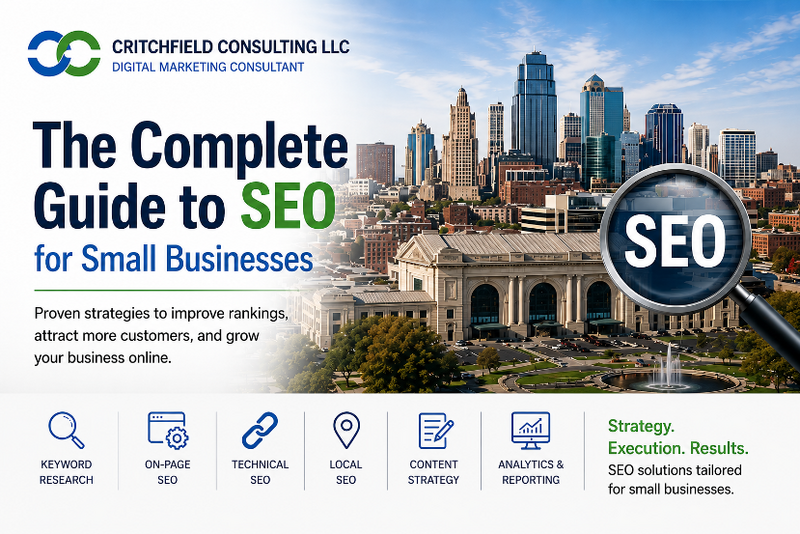
Strategy-Driven Website Design for Small Business Growth
For many small businesses, a website is one of the most important investments they will make. It represents your brand, communicates your services, and often serves as your primary source of new leads. However, not all websites perform the way business owners expect.
The reality is simple: most websites don’t fail because of poor design. They fail because of a lack of strategy.
At Critchfield Consulting, we’ve worked with businesses across multiple industries, including many here in Kansas City, and the common pattern is clear. Companies invest in a new website expecting growth, but without the right structure, messaging, and SEO foundation, performance never follows.
A high-performing website is not just built, it is strategically engineered.
What Makes a High-Performing Small Business Website?
A successful website does more than look good. It guides visitors, communicates clearly, and drives action.
- Clear messaging that immediately explains what your business does and who it serves
- Logical structure that makes it easy for users to navigate
- Search engine optimization (SEO) to help customers find you online
- Conversion-focused design that turns visitors into leads
- Mobile responsiveness for today’s on-the-go users
When these elements work together, your website becomes a true business asset instead of just an online brochure.
Website Design vs Website Strategy: Why Most Businesses Get It Wrong
One of the biggest misconceptions in digital marketing is that design comes first.
Traditional web agencies often focus on visuals before strategy. They prioritize layout, colors, and templates without fully understanding how the website should function as a marketing tool.
Strategy-led website design flips that process.
Before design begins, you must define:
- How users will move through the website
- What actions you want them to take once there
- How pages support SEO and search intent throughout the site
- How your business is branded and positioned against competitors
This is why we emphasize strategy-driven website design at Critchfield Consulting. The decisions made before development determine how your website performs after launch.
Essential Pages Every Small Business Website Needs
Every high-performing website is built on a strong foundation of core pages.
- Homepage — Your first impression and primary conversion driver
- Product & Service Pages — Detailed pages for each offering to support SEO and clarity
- Company Pages — Builds trust in what you do, shows who you are and explains your story
- Contact Page — Makes it easy for customers to take action
- Blog or Resource Section — Supports SEO, online credibility and authority
- Testimonials or Reviews — Reinforces credibility others have used and use your company
- Location Pages — Critical for local SEO, and regional digital performance
Each page should have a clear purpose and support your overall marketing strategy.
How Website Navigation Impacts User Experience and SEO
Your navigation structure plays a critical role in both user experience and search engine performance.
If users can’t find what they need quickly, they leave.
Strong navigation includes:
- Clear menu structure
- Logical page hierarchy
- Easy access to key services
- Consistent navigation across all pages
For a deeper breakdown, explore our guide on why website navigation matters.
SEO and Website Design: Why They Must Work Together
SEO is not something you add after your website is built. It must be integrated from the beginning.
A well-optimized website helps search engines understand:
- What your business offers
- Who your target audience is
- Which pages should rank for specific keywords
This includes proper structure, keyword targeting, internal linking, and content development.
If your website isn’t built with SEO in mind, it will struggle to generate traffic regardless of how good it looks.
Learn more about our SEO services and how we approach search visibility.
How to Design a Website That Converts Visitors Into Leads
Traffic alone doesn’t grow your business. Conversions do.
A high-performing website guides users toward action.
- Clear calls-to-action placed throughout the site
- Simple contact forms that are easy to complete
- Trust signals such as reviews and case studies
- Compelling messaging that speaks directly to your audience
This is where strategy and design intersect. Every page should have a defined purpose. Learn how to create higher-converting web pages.
Common Website Design Mistakes That Hurt Small Businesses
Even well-designed websites can underperform if key fundamentals are missing.
- Poor navigation and confusing structure
- Weak or unclear messaging
- No SEO strategy
- Poor Imagery or lack of digital assets
- Lack of conversion pathways
- Outdated or inconsistent design
We break this down further in our article on common website design mistakes.
Custom vs Template Websites: What’s Best for Your Business?
Not every business needs the same type of website.
Template websites can be cost-effective and fast to launch, but they often come with limitations.
Custom websites provide flexibility, scalability, and a stronger SEO foundation.
The right choice depends on your goals, budget, and long-term growth plans.
Learn more in our digital guide on custom vs template website design.
When a Website Redesign Is (and Isn’t) the Right Move
Many businesses assume they need a new website when performance drops. That isn’t always the case.
Sometimes the issue is not the website itself, but the strategy behind it.
Before committing to a redesign, it’s important to evaluate:
- Content effectiveness
- SEO and programming performance
- Conversion structure
- User experience
- Competitor Analysis
Explore our insights on when a redesign isn’t the solution.
The Role of Content in Website Performance
Content is one of the most important drivers of website success.
Strong content helps:
- Improve search rankings
- Communicate your value clearly
- Build trust with your audience
- Support long-term marketing growth
Without strong content, even the best-designed website will struggle to perform. Here's some added insight into copywriting and website content.
How AI Is Changing Website Design and Search Behavior
Search behavior is evolving rapidly with the rise of AI-driven platforms.
Today’s websites must be structured not just for search engines, but also for AI generative systems that summarize and recommend content.
This means:
- Clear headings and structure
- Concise, valuable content
- Strong topical authority throughout the site
We explore this further in our article on AI search and generative SEO.
Website Design for Small Businesses in Kansas City
For businesses located in Kansas City, your website plays an even greater role in attracting local customers.
Local SEO and website structure must work together to ensure your business appears in relevant searches.
This includes:
- Location-specific content
- Clear service area pages
- Optimized Google Business presence
- Consistent branding across platforms
- Error free citation directory (NAP) listings
Whether you serve a local market or operate nationally, your website should be built to support both visibility and conversion. Explore how to localize your strategy with this free guide to Kansas City website design.
What to Expect From a Website Design Process
A successful website project follows a structured process.
- Discovery and evaluation
- Strategy development
- Content and structure planning
- Design and development
- Testing, proofing and optimization
- Launch and promotion
This process ensures that every element of your website supports your business goals. Browse these Critchfield Consulting project case studies and read how some of our clients stories began.
How Critchfield Consulting Approaches Website Design Differently
At Critchfield Consulting, we take a strategy-first, consultant-led approach to website design.
We don’t just build websites. We help businesses create digital platforms that support long-term growth.
- Strategy-led planning before design begins
- SEO-focused structure for long-term visibility
- Custom website development tailored to your business
- Hands-on implementation throughout the entire process
- Continued consulting and analysis post website launch
If you’re unsure where your current website stands, a digital marketing evaluation is the best place to start.
Final Thoughts: Building a Website That Actually Grows Your Business
A website should do more than exist online. It should actively support your business objectives and goals.
When built with the right strategy, your website becomes one of your most valuable marketing assets.
If your current website isn’t delivering results, the issue may not be design alone. It may be the strategy behind it.
Ready to take the next step?
Contact Critchfield Consulting at 816-718-6617 or request a consultation to evaluate your current website and identify opportunities for growth.
Frequently Asked Questions
What is the most important part of website design?
Strategy is the most important component. Without it, design alone will not drive results.
How much does a small business website cost?
Costs vary depending on complexity, but generally a good template design costs around $2,500 and a custom design ranges from $5,000 to $10,000.
Do I need SEO for my website?
Yes. Without SEO, your website will struggle to generate traffic from search engines.
How long does it take to build a website?
Most custom websites take several months depending on scope and content.
Should I redesign my website or improve my current one?
That depends on your current structure and performance. A strategic evaluation helps determine the right path.